Those dark, winding streaks spreading across your roof are not simple dirt stains. They are Gloeocapsa magma, a living cyanobacterium that feeds on the limestone filler in asphalt shingles. As it grows, it slowly degrades the structural integrity of your roofing material, accelerates granule loss, and traps heat that drives up attic temperatures and cooling costs. Left untreated, it can cut your roof’s service life by half and turn a manageable cleaning into a full replacement project costing $8,000 to $15,000.
Call (631) 557-5484 today for a free soft wash roof cleaning estimate on your Long Island home.
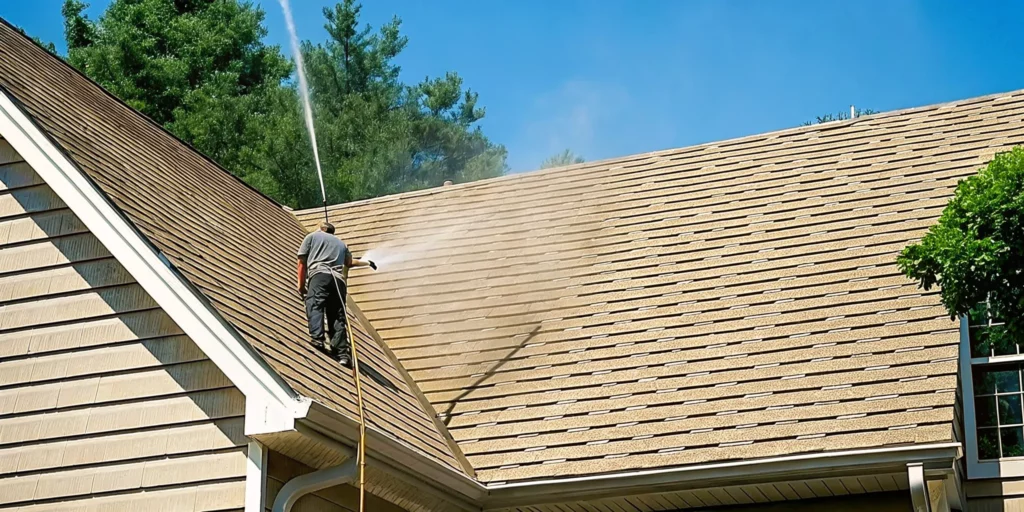
Soft wash roof cleaning is the only safe, effective method for removing Gloeocapsa magma (black algae), moss, and lichen from residential roofing without damaging the shingles. Unlike pressure washing, which blasts water at 1,500 to 4,000 PSI and strips protective granules. Soft washing uses specialized biodegradable detergents at pressures no higher than 90 PSI , roughly the force of a garden hose. The cleaning solution penetrates the root structure of biological growth, killing it at the source. Results last 4 to 6 times longer than pressure washing, the process uses one-third the water, and it preserves your shingle warranty. For Long Island homeowners facing humid summers, coastal salt spray, and rapid moss regrowth, this method is the clear choice for protecting both curb appeal and property value.
What Is Soft Wash Roof Cleaning and How Does It Work?
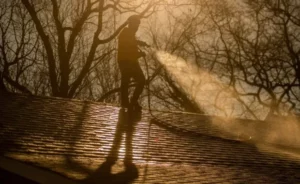
Soft wash roof cleaning is a low-pressure cleaning method that uses biodegradable chemical solutions , primarily sodium hypochlorite at concentrations below 3%. Combined with a surfactant , to kill mold, algae, moss, and lichen at the root. The pressure never exceeds 90 PSI, which means the water rinses away dead organic matter without eroding the protective mineral granules embedded in asphalt shingles.
Standard pressure washers operate at 1,500 to 4,000 pounds per square inch (PSI). That force is designed for concrete driveways and metal equipment , not for the delicate layered construction of a residential roof. Soft washing turns the equation around: chemistry does the heavy lifting, and water is merely the delivery and rinse vehicle.
Cleaning with Chemistry Instead of Force
The heart of the soft wash system lies in the biodegradable cleaning agents. Gulf2Bay Softwash uses EPA-compliant, VOC-compliant solutions that break down into inert compounds within 20 days of application. These chemicals target the cellular structure of organic growth at the molecular level, destroying the root system rather than merely wiping away surface discoloration.
- Dwell time of 10 to 20 minutes allows the solution to penetrate porous shingle surfaces and kill embedded spores.
- Low-pressure rinse at or below 90 PSI washes away dead material without dislodging granules or forcing water under shingle laps.
- One-third the water volume of conventional pressure washing, reducing runoff and protecting landscaping.
- Safe for all roofing materials: asphalt shingles, cedar shake, clay tile, slate, stone-coated steel, metal, and solar tiles.
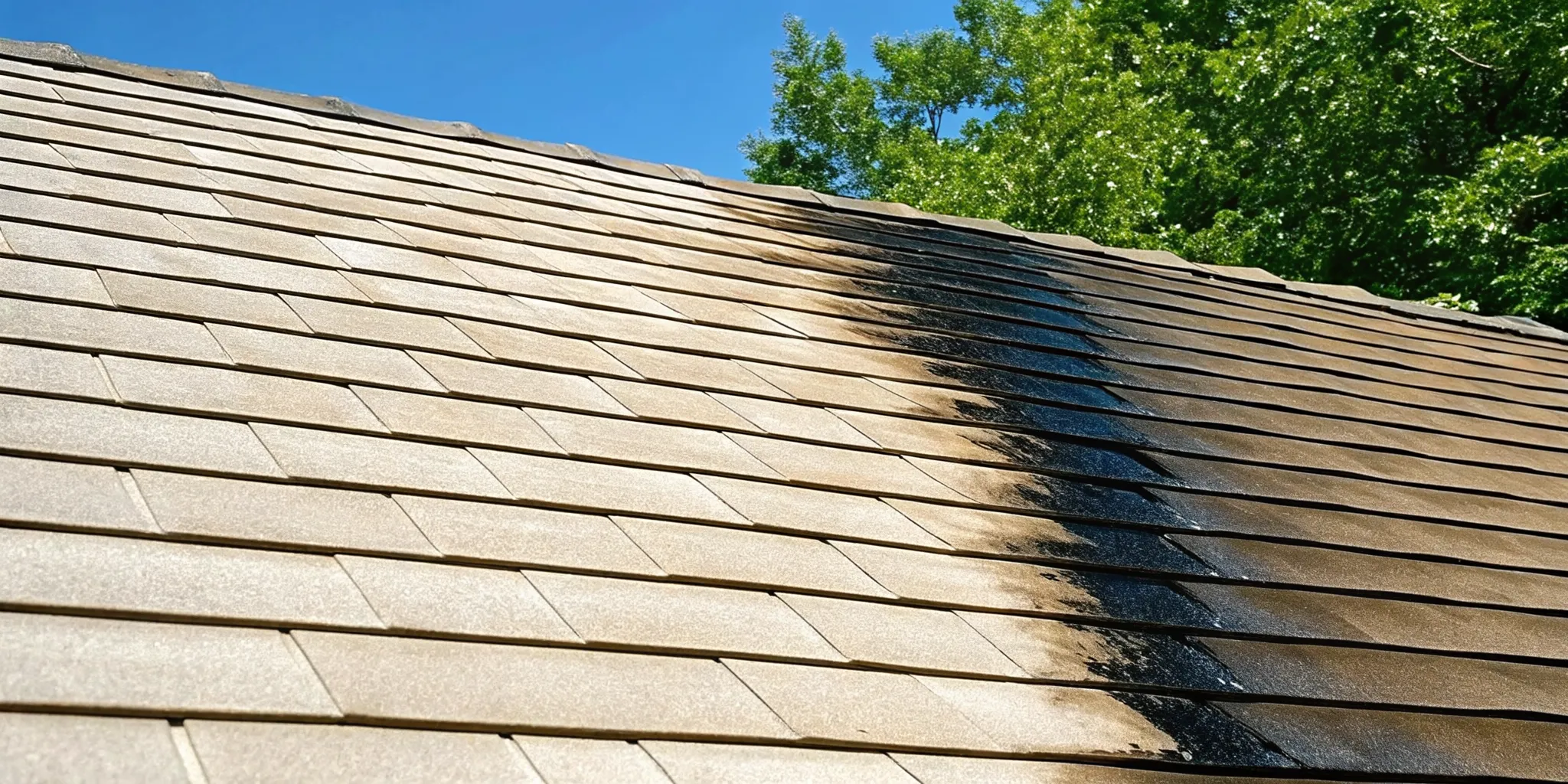
The method is so effective that it is endorsed by SoftWash Systems. An organization that has cleaned more than 500,000 structures worldwide and whose products are approved for use on theme parks, government buildings, and university campuses.
What Is Gloeocapsa Magma and Why Does It Matter?
Gloeocapsa magma is a cyanobacterium that appears as dark black or dark green vertical streaks on asphalt shingles. It feeds on the calcium carbonate (limestone) filler embedded in the shingle, slowly breaking down the material from the surface inward. The dark coloring absorbs solar radiation, raising attic temperatures by as much as 10 degrees Fahrenheit and increasing HVAC loads by 5 to 10 percent during summer months.
Research published in the journal Biofouling has documented how Gloeocapsa magma colonizes roofing materials and accelerates degradation through both mechanical and chemical pathways. The organism excretes organic acids that etch the shingle surface, creating microscopic fissures where moisture collects. Freeze-thaw cycles common in Long Island winters widen these fissures, leading to curling, cracking, and premature granule loss.
Pressure washing removes the visible discoloration but leaves the root structure intact buried inside the micro-porous surface of the shingle. Within 6 to 12 months, the algae regrows from those surviving roots, and the streaks return darker than before. Soft washing penetrates those pores and kills the entire organism, which is why treated roofs stay clean for 4 to 6 years rather than 6 to 12 months.
Why Proper Technique Matters for Long Island Homes
The Long Island climate presents unique challenges for roof maintenance. High humidity from June through September creates ideal conditions for algal and moss growth. Salt spray carried by onshore winds accelerates the chemical breakdown of roofing materials. Meanwhile, freeze-thaw cycles from November through March exploit existing micro-cracks, expanding them into full structural damage.
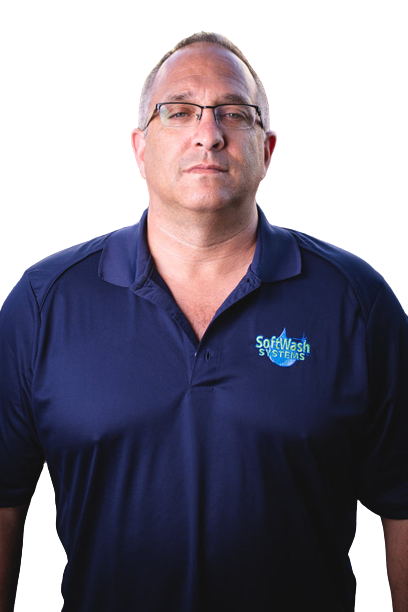
Gulf2Bay Softwash brings more than 20 years of field experience to every job. The founder, David Jarett, grew up in the Hamptons construction industry where his father was a custom home builder on the East End throughout the 1970s and 1980s. He has also owned a national award-winning chimney and gutter company employing 43 people across seven states. That depth of construction knowledge directly informs how the Gulf2Bay team approaches every roof: they understand substrate behavior, water intrusion paths, and the long-term consequences of shortcuts.
The company holds SoftWash Systems Authorized Professional certification and has completed soft washing on more than 4,200 houses across Long Island. Every project includes a free on-site assessment, a custom cleaning proposal based on the specific roof material and contamination level, and a 5-year transferable warranty that backs the work.
Why Pressure Washing Damages Your Roof (And Your Wallet)
Standard pressure washing uses 1,500 to 4,000 PSI of force to blast away surface debris. That force strips the protective ceramic mineral granules from asphalt shingles, forces water up under shingle laps into the decking, and can void the manufacturer’s warranty. A single pressure-washing job can reduce a roof’s remaining service life by 30 to 50 percent.
The damage is not always visible from the ground. By the time a homeowner notices leaks, curling shingles, or bare patches where granules have been stripped away, the underlying structural damage has already progressed. The cost of repairing that damage typically runs thousands of dollars , far more than the $200 to $600 saved by choosing a budget pressure-washing service.
Granule Loss Accelerates Aging
Asphalt shingles are constructed with a layer of ceramic-coated mineral granules embedded in the surface. These granules serve three functions: they reflect ultraviolet radiation, they shed water, and they provide the fire rating that meets building code. When a pressure washer blasts water across the roof at 2,000 to 4,000 PSI, it dislodges these granules by the thousands.
Once the granules are gone, the underlying asphalt is exposed directly to the sun. UV radiation hardens and cracks the asphalt, turning a flexible, watertight surface into a brittle, porous layer that leaks. A shingle that should last 25 to 30 years develops bald spots in as little as 3 to 5 years after a single aggressive pressure washing.
Water Intrusion Causes Hidden Structural Rot
Pressure washing does not just remove granules , it also drives water into places it should never go. The force of a pressure washer can bypass the natural lap joints of asphalt shingles, the same joints designed to shed rainwater harmlessly down the roof slope. Once water penetrates these laps, it saturates the underlying felt paper and wooden roof deck.
Trapped moisture in the decking creates ideal conditions for Serpula lacrymans and other wood-rot fungi. Over 12 to 24 months, the decking can lose structural integrity, requiring partial or complete deck replacement at a cost of $3,000 to $8,000 or more. Attic mold, musty odors, and increased indoor humidity are early warning signs that water intrusion has already occurred.
Warranty Voiding Is a Real Risk
Nearly all asphalt shingle manufacturers , including GAF, CertainTeed, Owens Corning, and IKO , explicitly prohibit high-pressure cleaning in their warranty terms. A standard warranty reads: “Do not use power washers or high-pressure spray equipment on shingles. As this may damage the shingles and void the warranty.” If a homeowner files a warranty claim after a pressure-washing incident. Manufacturers routinely inspect for granule loss patterns consistent with high-pressure cleaning and deny coverage.
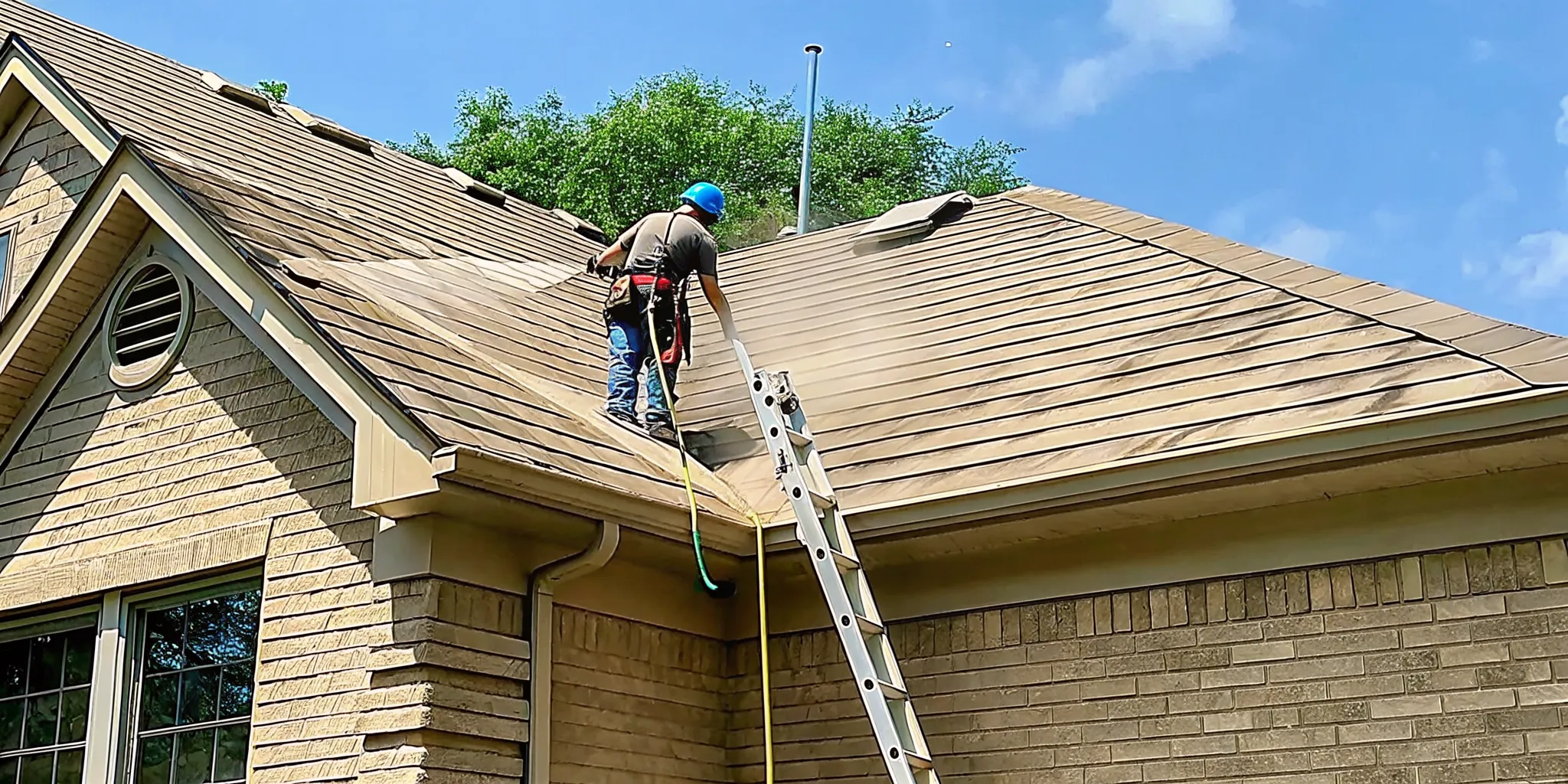
The roof cleaning cost on Long Island ranges from $300 to $800 for professional soft washing, while pressure washing services charge $250 to $600. The $50 to $200 difference is trivial compared with the $8,000 to $15,000 cost of a full roof replacement that pressure damage can trigger.
The Soft Wash Roof Cleaning Process: Step by Step
Professional soft wash roof cleaning follows a six-step protocol: on-site inspection and algae identification, property protection and plant soaking. Custom chemical solution application, 10-to-20 minute dwell time for root kill, low-pressure rinse at or below 90 PSI, and final quality inspection. The entire process takes 2 to 4 hours for a typical Long Island home and leaves the roof clean, bright, and protected for years.
Gulf2Bay Softwash follows a proven, repeatable process developed over thousands of successful roof cleanings on Long Island homes ranging from historic Hamptons estates to modern Bay Shore residences.
- Full Roof Assessment: The team walks the roof surface to identify growth type, density, and distribution; evaluates shingle condition; and documents any pre-existing damage with photographs. They also check for signs of Gloeocapsa magma, moss colonies, lichen buildup, and organic debris accumulation in valleys and around penetrations.
- Property Protection: All plants, shrubs, and lawn areas within the splash zone are thoroughly soaked with fresh water before any chemicals are applied. Gutters are flushed to remove debris that could trap moisture. Windows, doors, and outdoor furniture are covered or moved clear of the work area.
- Solution Application: Using a SoftWash Systems metering pump calibrated to deliver the precise dilution ratio for the identified contaminant load. The team applies the biodegradable cleaning solution evenly across the entire roof surface. The concentration is adjusted based on shingle type, age, and sensitivity , cedar shake, for example, receives a gentler formulation than composition asphalt.
- Dwell and Kill Phase: The solution remains on the roof for 10 to 20 minutes, depending on temperature and contamination density. During this window, the surfactants break the surface tension of the cellular walls of algae. Moss, and lichen, allowing the active biocide to penetrate and destroy the root structure. The homeowner can see the dark stains visibly lighten as the kill progresses.
- Low-Pressure Rinse: A fan-tip nozzle delivers fresh water at or below 90 PSI , not enough to damage shingles or dislodge granules. But sufficient to rinse away dead organic matter and residual chemicals. The team works from the ridge down, ensuring complete runoff without pooling.
- Final Quality Check: After rinsing, the team inspects the roof for any missed areas, checks gutters and downspouts for debris, and conducts a walk-around with the homeowner to confirm satisfaction. All protective coverings are removed and the job site is returned to its original condition.
Every roof cleaning is backed by a 5-year transferable warranty. In year one, Gulf2Bay provides a 12-month spot-free guarantee. Years two through four include a 50 percent discount on the original retreatment price. Year five offers a 20 percent discount. The warranty transfers to the next homeowner if you sell your property, adding tangible value at resale time.
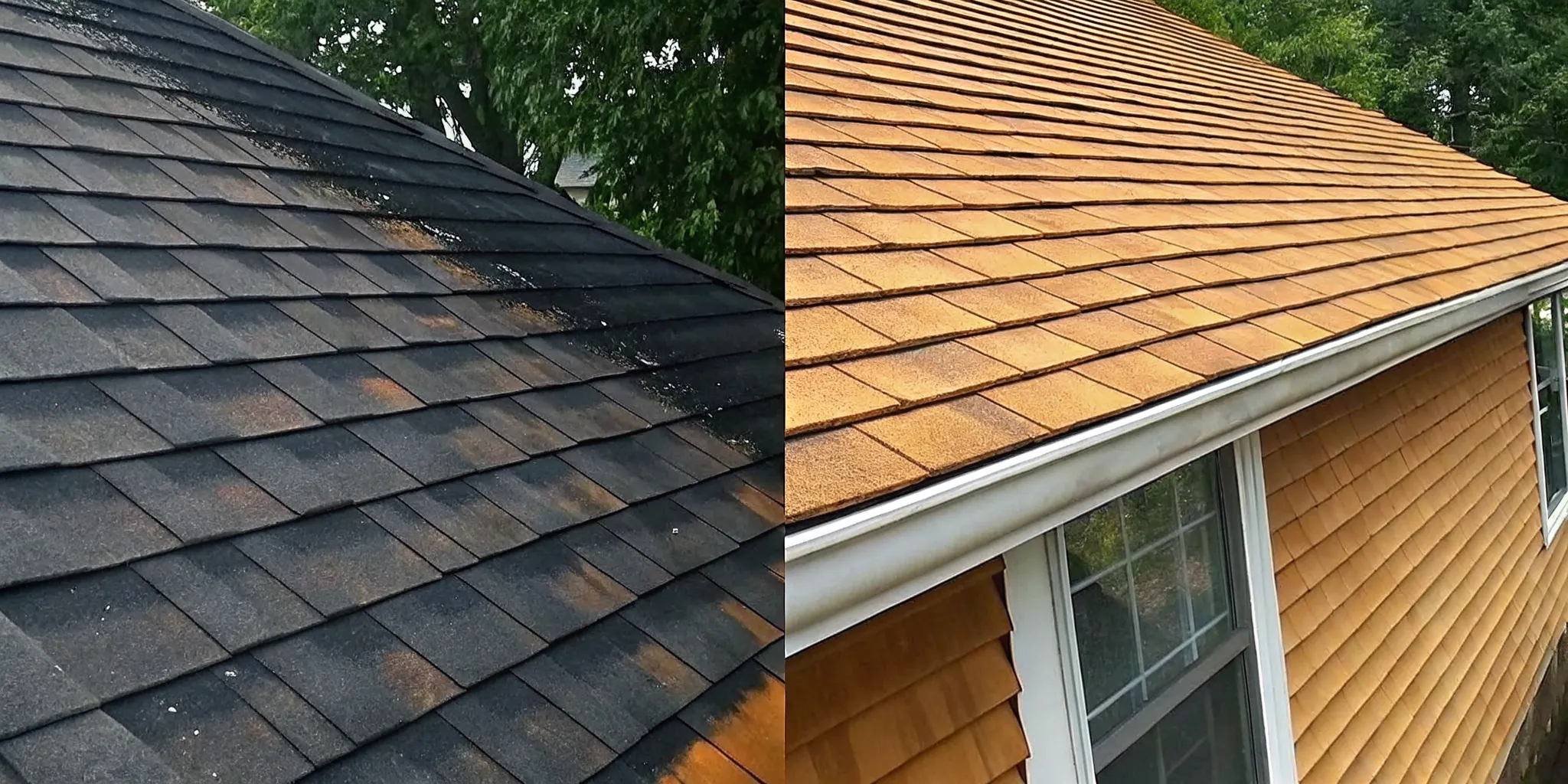
How Results Compare Across Roof Types
| Roof Material | Soft Wash Safe? | Pressure Wash Safe? | Typical Result Duration |
|---|---|---|---|
| Asphalt shingles | Yes | No , strips granules | 4 to 6 years |
| Cedar shake | Yes | No , shreds wood fibers | 3 to 5 years |
| Clay tile | Yes | No , cracks glazing | 5 to 7 years |
| Slate | Yes | No , fractures edges | 5 to 8 years |
| Stone-coated steel | Yes | Use with extreme caution | 3 to 5 years |
| Solar tiles | Yes | No , voids solar warranty | 4 to 6 years |
Soft Wash Roof Cleaning vs. Pressure Washing: Which Is Right for Your Long Island Home?
For virtually every residential roof on Long Island, soft wash roof cleaning is the superior choice. It preserves shingle integrity, keeps your warranty valid, uses less water, and delivers results that last 4 to 6 times longer. Pressure washing is only appropriate for hard, non-porous surfaces like concrete driveways, stone patios, and metal outdoor equipment , never for asphalt, cedar, tile, or slate roofing.
The choice ultimately comes down to what you are trying to achieve. If your goal is to blast visible dirt off the fastest way possible regardless of long-term consequences, pressure washing will do that. If your goal is to remove biological growth, restore your roof’s original appearance, extend its service life, and protect your investment, soft washing is the only rational option.
| Factor | Soft Wash Roof Cleaning | Standard Pressure Washing |
|---|---|---|
| Pressure level | 90 PSI or less (garden hose force) | 1,500 to 4,000 PSI (tile-stripping force) |
| Cleaning mechanism | Biodegradable chemicals kill roots at molecular level | High-velocity water blasts surface dirt |
| Effect on shingle granules | Granules stay intact and protected | Granules are dislodged and lost |
| Result longevity | 4 to 6 years | 6 to 12 months |
| Water consumption | One-third of pressure washing volume | High volume, high runoff |
| Environmental impact | Biodegradable solutions, safe for plants and pets | Chemical runoff, potential for erosion |
| Warranty protection | Preserves manufacturer warranty + 5-year work warranty | Voids most manufacturer warranties |
| Typical cost (roof only) | $300 to $800 | $250 to $600 |
| Safe for all roof types | Yes | Asphalt and wood only , with damage risk |
Choosing the Right Service for Your Property
Long Island homeowners face specific conditions that make this decision especially important. Salt air accelerates corrosion and biological growth. Humid summers create near-ideal conditions for moss and algae colonization. Luxury properties in the Hamptons and Gold Coast often feature cedar shake, slate, or imported clay tile , all materials that are permanently damaged by high-pressure cleaning. Gulf2Bay Softwash has extensive experience with these premium materials and tailors every cleaning protocol to the specific substrate.
The company’s service portfolio spans 12 distinct exterior cleaning and restoration categories. Homeowners can bundle a roof cleaning with professional house washing, gutter cleaning and brightening, or deck restoration and paver sealing. Bundling three or more services saves 10 percent across the entire project and reduces the per-service cost of each.
For homeowners preparing to sell, a professional soft wash roof cleaning is one of the highest-ROI pre-listing improvements available. The visual impact of a clean, streak-free roof versus one covered in black algae is immediately apparent in listing photos and during showings. Real estate agents consistently cite curb appeal as the single most important factor in a buyer’s first impression.
Frequently Asked Questions
Is soft wash roof cleaning better than power washing?
Yes, soft washing is significantly safer and more effective for residential roofing. Power washers use 1,500 to 4,000 PSI of force, which strips the protective granules from asphalt shingles and drives water under shingle laps into the roof deck. Soft washing uses biodegradable chemicals at pressures below 90 PSI to kill algae, moss, and lichen at the root without damaging the roofing material. The life cycle of a roof treated with soft washing is 4 to 6 times longer than one cleaned with high-pressure methods, and the manufacturer’s warranty remains intact.
How much does professional roof soft washing cost?
On Long Island, professional soft wash roof cleaning typically ranges from $300 to $800 for a standard residential roof. The final price depends on roof size, pitch, material type, the extent of biological contamination, and accessibility. This is slightly more than a basic pressure wash ($250 to $600). But the value is significantly higher because the results last 4 to 6 years instead of 6 to 12 months, and there is zero risk of structural damage. Gulf2Bay Softwash provides free on-site assessments and detailed written quotes before any work begins.
How long does a soft wash roof cleaning last?
A professionally applied soft wash treatment typically keeps a roof clean for 4 to 6 years. This extended duration is possible because the cleaning solution kills the entire organism. Including the root structure embedded within the porous shingle surface , rather than just wiping away the visible discoloration. Environmental factors such as heavy shade, proximity to salt water, and prevailing humidity can influence the exact interval. But the 4-to-6-year window is the standard for properly treated roofs across Long Island.
Can I soft wash my own roof?
Do-it-yourself roof cleaning carries significant risks. The chemicals require precise dilution ratios , too concentrated and they damage shingles and kill landscaping; too dilute and they fail to kill the root structure. Soft wash pumps must deliver consistent low pressure; a standard garden sprayer cannot achieve the proper flow rate or coverage. Walking on a wet, soapy roof is a fall hazard that causes hundreds of emergency room visits annually. Professional teams carry liability insurance, use fall-protection equipment, and have the training to adjust chemical formulations for different roof materials and contamination levels.
Does roof soft washing prevent future algae growth?
Soft washing kills existing algae, moss, and lichen at the root, which significantly delays regrowth compared with pressure washing. However, no treatment permanently prevents future colonization because Gloeocapsa magma spores are airborne and constantly settle on roof surfaces. What soft washing provides is a clean slate: the spores must begin the colonization process from scratch. Which typically takes 4 to 6 years before growth becomes visible again. Regular roof assessments every 3 to 5 years help catch regrowth early and keep the roof in optimal condition.
Will soft washing remove black streaks from my roof?
Yes. Black streaks on asphalt shingles are almost always caused by Gloeocapsa magma, and soft washing is specifically designed to remove them. The biodegradable cleaning solution penetrates the cellular structure of the algae, kills it, and breaks down the pigmentation that creates the dark appearance. The low-pressure rinse then washes away the dead organic material, revealing the original shingle color underneath. Homeowners typically see a dramatic transformation: the roof appears several shades lighter and the contrast between clean and previously affected areas disappears.
Protect Your Long Island Roof with Professional Soft Washing
Black algae, moss, and lichen are not cosmetic problems. They are active biological agents that progressively degrade your roofing materials, reduce energy efficiency, and lower your property value. Pressure washing may seem like a faster or cheaper solution, but the hidden damage it causes , granule loss. Water intrusion, warranty voiding , frequently leads to repair costs that dwarf the initial savings.
Soft wash roof cleaning from Gulf2Bay Softwash delivers the opposite outcome: a chemically precise. Low-pressure treatment that preserves your shingles, protects your warranty, and keeps your roof looking like new for years. Every job is performed by a SoftWash Systems Certified team with over 20 years of Long Island field experience and is backed by a 5-year transferable warranty.
Ready to protect your investment? Call (631) 557-5484 or schedule your free roof cleaning estimate online today.