A second home should look prepared for the season without requiring you to climb a ladder. It should be ready before the first guests arrive. That matters on Hamptons properties with tall rooflines and coastal exposure.
For permanent holiday lighting hamptons homeowners, the practical solution is a discreet track-mounted system using commercial-grade UL-rated lights, supported by seasonal installation, maintenance, removal, and off-season storage.
Request a lighting consultation for a property-specific plan.
The value is not simply leaving lights in place. A well-designed system keeps the mounting hardware visually quiet, creates a consistent appearance each season, and gives second-home owners a dependable service plan even when they are away. The track, lighting, and annual service model work together to protect both the look of the home and the convenience of owning it.
What permanent holiday lighting means for a Hamptons home
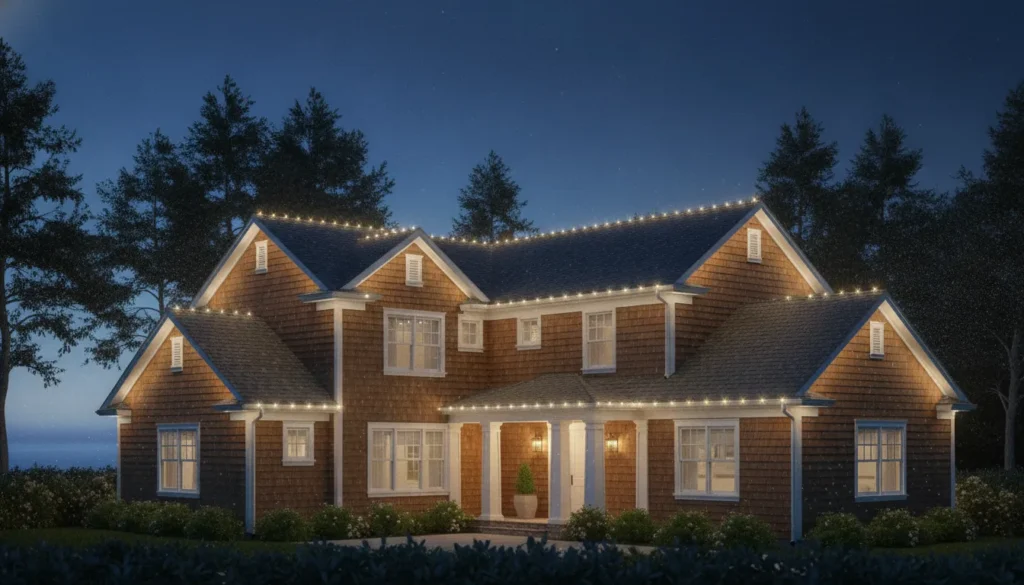
Permanent holiday lighting is a designed exterior lighting system built around the architecture of the home. Not a weekend of attaching retail string lights to gutters and roof edges. For a Hamptons residence, the goal is a clean seasonal display that fits the roofline, entry, landscaping, and overall character of the property.
The system uses commercial-grade, UL-rated lights installed on a discrete permanent mounting track. The track stays in place, while the lighting is installed for the holiday season, maintained as needed, then removed and stored for the off-season.
A complete seasonal service, not a one-time install
The practical difference is the service model. A residential lighting plan can include personalized design, professional installation, maintenance, complete takedown, and off-season storage. That keeps the display consistent from year to year and avoids rebuilding the design from scratch each season.
Maintenance matters on a coastal property. If a bulb or wire needs attention, the documented service includes bulb and wire replacement with a stated 24- to 72-hour response window. A lighting diagram can also preserve the placement and layout for future seasonal visits.
Designed for the home and the way it is used
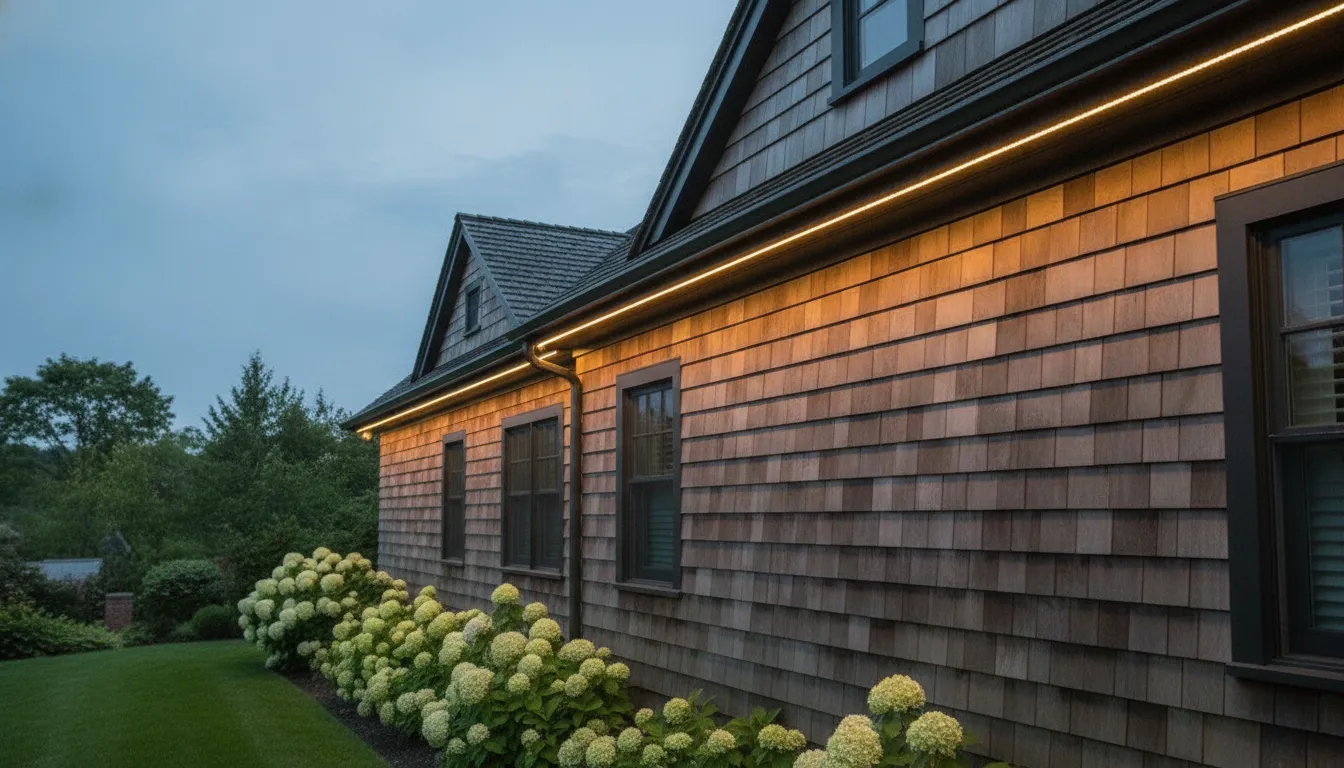
Permanent track-mounted lighting is intended to look intentional when it is on and unobtrusive when it is off. Lights can outline selected architectural features or support a broader design with options such as wreaths, garlands, bows, garden lights, or other documented decorative elements. The track keeps the installation discrete and helps avoid the visible wires and uneven runs associated with standard retail strings.
That combination of safety, convenience, and controlled appearance suits Hamptons homes with tall or steep rooflines. It also suits second homes that may not be occupied during every service visit. Explore Long Island holiday lighting to see how the residential service is structured.
Why permanent holiday lighting fits Hamptons second homes
Seasonal service without being on site
A second home should not require a December trip just to coordinate roofline decorations. A permanent track-mounted system gives the property a defined lighting layout, while the annual service handles installation, removal, and off-season storage. That keeps the seasonal work organized even when the owners are elsewhere.
Professional installation is especially useful for homes with tall, steep, or difficult-to-access rooflines. The crew can work from the agreed design instead of asking an owner or caretaker to improvise with ladders, retail string lights, and extension cords.
Gulf2Bay’s documented Hamptons service region includes Hampton Bays, East Hampton, West Hampton, and Montauk. Review the full Hamptons service area when planning coverage for a second home or multiple properties.
A repeatable plan for every season
The lighting diagram is practical for a property that receives recurring service. It records the intended layout so future installation can follow the original design rather than starting from scratch. That helps maintain a consistent appearance across rooflines, entry features, and other selected areas.
Seasonal maintenance also matters when no one is living at the house. The service package includes bulb and wire replacement, with a documented 24 to 72 hour response window. That does not remove the need for coordination, but it gives an owner a defined process when a lighting issue is reported during the season.
For second-home owners, the advantage is not simply leaving lights in place. It is having professional installation, scheduled takedown, storage, and a documented plan tied to the property. The result is a more manageable holiday-lighting routine across the Hamptons without making the homeowner’s presence a requirement for every visit.
How to make a permanent lighting installation safer
Tall Hamptons rooflines, steep pitches, coastal wind, and wet weather make holiday lighting a job for careful planning. A permanent mounting track can reduce repeated ladder work, but it does not remove the need for inspections, correct electrical limits, or secure installation.
Use this yearly safety sequence
- Inspect before the season starts. Check every accessible light, connection, mounting point, and power lead before the system is switched on. The U.S. Fire Administration recommends inspecting holiday lights each year and throwing away strands with frayed or pinched wires. Do not reuse a damaged section by taping over it. Replace it.
- Confirm the electrical load. Follow the manufacturer’s instructions for the maximum number of connected strands. Do not add extra runs because a roofline appears to have room for them. Staying within the stated limit helps prevent overloaded connections and unnecessary heat.
- Use properly listed, outdoor-rated equipment. Choose lights listed by an independent laboratory such as UL or Intertek/ETL, and use only products rated for outdoor conditions. Gulf2Bay’s documented system uses commercial-grade UL-rated lights on a discrete permanent mounting track. Massachusetts fire-safety guidance also recommends following the manufacturer’s directions and using outdoor-rated lights. Review the Massachusetts guidance, which is general safety information, not New York law.
- Prefer LED where the system allows it. LED lights are cooler and use less electricity than many older lighting types, according to the Massachusetts guidance. That does not make a damaged or overloaded installation safe, so inspect the wiring and connections regardless of bulb type.
- Anchor for coastal weather and use the right access plan. Secure outdoor lights and decorations against wind and storms with insulated holders or hooks where appropriate. For large, steep, or difficult-to-access rooflines, professional installation can keep the work off improvised ladders and help the system follow the roof’s actual geometry. It cannot guarantee safety in every condition, so postpone work during unsafe weather and inspect after severe storms. The U.S. Fire Administration holiday safety guidance provides additional general precautions.
A yearly install, maintenance, takedown, and storage plan gives second-home owners a consistent point for these checks. The important question is not whether a system is called permanent. It is whether the equipment, connections, anchors, and access plan are reviewed before each season.
How the track system protects the look of a coastal property
Clean lines along cedar, trim, and rooflines
Hamptons homes often rely on strong exterior lines. Those include cedar siding, detailed trim, dormers, gables, and long roof edges. Holiday lighting should follow those lines instead of competing with them.
A discrete permanent mounting track keeps each run positioned consistently along the architecture. The lights read as one deliberate design rather than a collection of loose strands.
That distinction matters on a coastal property. Standard retail string lights can leave visible wires, uneven spacing, sagging sections, or hardware that distracts from the home after installation. The track system is designed to stay visually restrained while the lights are in place. Helping the seasonal display complement the cedar and trim instead of covering up their shape.
Commercial-grade lighting with a controlled finish
Gulf2Bay’s documented holiday-lighting service uses commercial-grade LED lighting with UL-rated lights on a permanent mounting-track system. The equipment and placement are selected around the property’s architecture, roofline access, and the look the homeowner wants to create. The result is a more controlled outline across the front elevation, entry, roof edges, or other selected features.
The design does not have to stop at a roofline. Options documented for the service include wreaths, garlands, bows, icicle lights, bells, garden lights, C-7 lights, sculptures, and animated sets. Those elements can add visual weight at an entry or bring attention to a focal feature without turning every part of the facade into a competing display.
See Long Island holiday lighting options for the documented residential service and design details.
A finished look that can be repeated each season
A permanent track also supports consistency from year to year. Gulf2Bay’s service includes professional installation, maintenance, complete takedown, and off-season storage as part of recurring seasonal service. That means the design can be restored along the same architectural lines rather than recreated from the ground up each winter. For homeowners who care about a coordinated coastal exterior. The value is simple: the lights enhance the property for the season without making the installation itself the focal point.
Permanent lighting installation versus seasonal DIY
The difference is the service plan, not only the fixture
Seasonal DIY can work for a small, accessible property. You buy retail string lights, inspect them, climb to install them, take them down after the holidays, and find storage space for the next season. That cycle repeats every year, along with the need to remember which strand belongs on each section of the house.
A permanent track system changes the recurring work. Commercial-grade, UL-rated lights sit on a discrete mounting track, while the annual service covers installation, removal, and off-season storage. The track remains in place, so the roofline does not need to be mapped and fitted from scratch each season.
| Consideration | Permanent track service | Seasonal DIY |
|---|---|---|
| Installation | Professional installation follows the property’s roofline and uses the existing discrete track. | The homeowner measures, positions, secures, and reconnects retail strings each season. |
| Removal and storage | Lights are removed after the season and stored as part of a recurring annual service. | Removal, labeling, packing, and dry off-season storage remain the homeowner’s responsibility. |
| Roofline access | Useful for tall, steep, or difficult-to-access rooflines where repeated ladder work is undesirable. | Requires repeated personal access to eaves, peaks, dormers, and other elevated areas. |
| Appearance | Consistent spacing and a discreet track create a coordinated look without loose visible wires. | Spacing, sagging, connectors, and visible wires can vary from one installation to the next. |
| Maintenance | The service includes bulb and wire replacement, with a documented 24 to 72 hour response window. | The homeowner must troubleshoot failures, replace damaged sections, and manage safety checks. |
| Installation record | A lighting diagram supports future installation and helps crews reproduce the intended layout. | The layout depends on the homeowner’s labels, photos, and memory from the prior season. |
The upfront installation and the annual service are separate parts of the decision. Removal, reinstall, and storage are recurring annual services. For a focused breakdown of what affects the initial project, see the permanent lighting installation cost guide.
For Hamptons second-home owners, the practical advantage is predictable seasonal coordination. The property can be prepared and cleared without requiring the owner to be present for every visit. That matters when the roofline is tall, the home is vacant between stays, or a consistent appearance is more important than the lowest-effort retail setup.
What to ask before choosing a Hamptons lighting service
Confirm what is installed and how it is maintained
Ask the provider to specify the light type, safety listing, mounting method, and wire management. These details belong in the proposal. For a permanent holiday lighting Hamptons installation, the system should be clearly defined, not described as a generic set of string lights.
Gulf2Bay’s documented approach uses commercial-grade, UL-rated lights on a discrete permanent mounting track. The hardware is designed to stay visually restrained when the lights are off.
Ask whether the design covers only rooflines or also includes features such as wreaths, garlands, trees, garden areas, or architectural details. The proposal should show the intended coverage and explain how the design fits the property’s scale. Pricing is quote-based and depends on property size and design complexity, so a remote guess is less useful than an assessment of the actual home.
Also clarify what happens after installation. A complete seasonal plan should state who handles removal, where the lights are stored during the off-season, and when the next installation is scheduled. Gulf2Bay documents installation, removal, and off-season storage as a recurring annual service, rather than treating the project as a one-time visit.
Get the service and warranty terms in writing
Ask how quickly the provider responds if a bulb fails, a wire is damaged, or part of the display stops working. Gulf2Bay documents free bulb and wire replacement with a stated 24- to 72-hour response window, plus a lighting diagram for future service. That detail matters for second-home owners who may not be on-site when an issue appears.
Confirm the warranty separately from the maintenance policy. Gulf2Bay documents a three-year manufacturer’s warranty for lighting fixtures. Ask what the warranty covers, who handles the claim, and whether labor or seasonal service is treated separately.
Finally, ask for a free on-site assessment and custom proposal. The visit should account for roofline access, property size, design complexity, mounting locations, and the seasonal service plan. Request a lighting consultation before choosing a provider.
Frequently Asked Questions
Are permanent track-mounted lights suitable for a Hamptons second home?
Yes. A permanent track system is useful when the home is occupied seasonally or the owner cannot be present for every visit. The track stays in place, while the lighting is installed, maintained, removed, and stored as part of a recurring seasonal service. That keeps the property ready for the holiday season without requiring a second-home owner to coordinate ladders, storage, and reinstallations from a distance.
Will the mounting track be visible during the rest of the year?
The system is designed around a discrete permanent mounting track rather than exposed retail string lights. Installed correctly, it follows the roofline and supports a cleaner appearance with fewer visible wires. The final layout should be reviewed against the home’s siding, trim, roof geometry, and coastal setting before installation.
How are tall or steep Hamptons rooflines handled?
Professional installation avoids asking homeowners or visiting guests to work from ladders on difficult rooflines. The service uses commercial-grade, UL-rated lights on the permanent track, with the layout planned for the home’s access points and architectural lines. A lighting diagram can also document the installation for future seasonal service.
What happens if a bulb or wire needs attention during the season?
The documented service includes bulb and wire replacement, with a stated response window of 24 to 72 hours. That maintenance support matters for second-home owners because a small failure can otherwise remain unnoticed between visits. The system is then taken down and placed in off-season storage after the holidays.
How is the cost of a permanent lighting project determined?
Pricing is quote-based. Property size and design complexity affect the proposal, so a site assessment is more useful than a generic per-foot estimate. Gulf2Bay documents free on-site assessments and custom proposals based on the property’s needs, including the roofline, desired coverage, track layout, and seasonal service requirements.
Schedule Your Hamptons Holiday Lighting Assessment
A property-specific assessment helps match the track layout, lighting design, and recurring seasonal service to your home’s rooflines and second-home schedule. Request a proposal that covers the details before installation begins.