.
Concrete can look permanently stained when the real problem is a mix of organic buildup, ground-in dirt, oil, sediment, gum, or rust. A driveway, walkway, or patio needs more than indiscriminate blasting, especially when nearby plants, windows, furniture, or coated areas are involved.
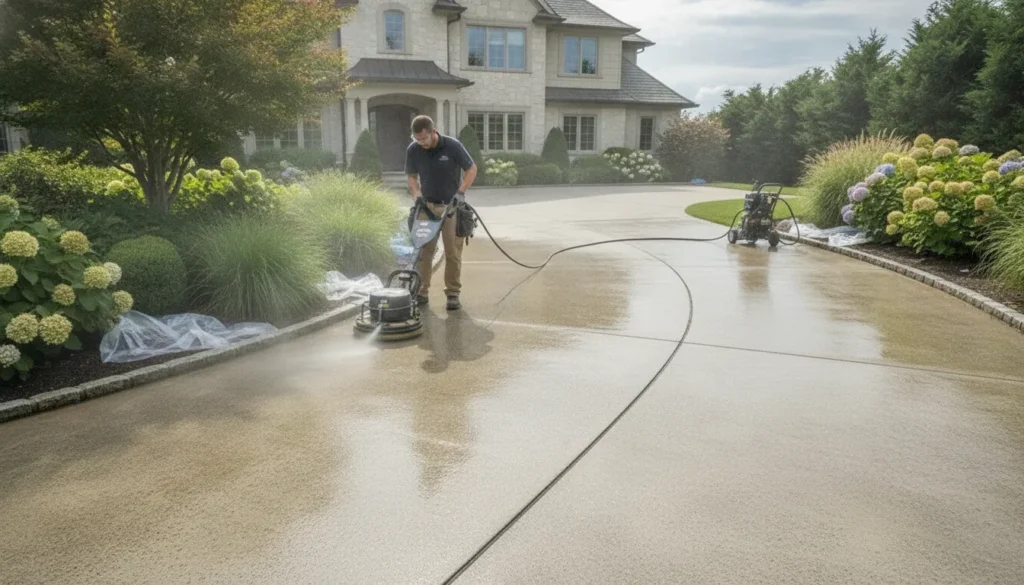
For Long Island homeowners, concrete cleaning services New York should include surface assessment, debris removal, appropriate cleaning agents, controlled rinsing, and protection for surrounding property. Depending on the stain and surface condition, the work may involve lower-pressure cleaning. A hover-disc cleaner with bristles, manual spot treatment, and an after-treatment rather than one aggressive pass.
Request a free on-site assessment and customized quote
The right service starts by identifying what is being cleaned and what is causing the discoloration. That determines whether the job calls for routine hard-surface cleaning, targeted stain treatment, or a more careful plan for mixed materials around the home.
What concrete cleaning services New York homeowners actually cover
Residential concrete cleaning covers the hard surfaces around the home that collect dirt, organic buildup, oil, sediment, and tracked-in grime. That usually means driveways, front walks, side paths, patios, entry areas, and related hardscape. Gulf2Bay lists driveway and walkway cleaning for concrete and hardscape surfaces as part of its residential services.
Driveways, walkways, patios, and connected hardscape
A driveway cleaning visit is not limited to the center of the slab. The work can include the approach to the garage, the edges where soil and leaves collect, and the transitions between concrete and landscaping. Walkways and patios receive the same surface-specific attention, with the method adjusted for their condition, nearby windows, furniture, plants, and other materials.
The first step is identifying the surface and evaluating the contamination. Coated and uncoated concrete should not be treated as interchangeable. A documented assessment includes checking the surface condition, clearing loose dirt and debris, and choosing equipment and cleaning agents suited to the area. Gulf2Bay’s process also includes protection for surrounding plants, furniture, and windows.
Concrete cleaning is different from paver sealing. Cleaning removes surface contamination and prepares the area for normal use or a later maintenance decision. Sealing is a separate treatment intended for compatible pavers or other specified surfaces. It should not be presented as an automatic part of every concrete cleaning service.
For Long Island homeowners, the service area includes Nassau County, Suffolk County, Bay Shore, West Babylon, and the Hamptons. That local coverage matters because a property may combine concrete with pavers, stone, brick, or other exterior materials that need different handling. Explore the full range of residential exterior cleaning services to see how those surfaces fit together.
A site assessment is the right way to define the scope when stains, coatings, mixed hardscape, or delicate edges are involved. It allows the cleaning plan to match the actual surface instead of treating every driveway, patio, and walkway the same way.
Why concrete gets stained on Long Island properties
Concrete stains are not all the same problem. A shaded walkway may collect organic buildup, while a driveway can hold ground-in dirt, oil, and sediment carried by tires and runoff. Gum bonds to the surface in small, stubborn spots. Rust can leave a distinct orange or brown mark that needs a different treatment from mildew or general grime.
Different stains need different treatments
Organic buildup often responds to a cleaning solution and the right amount of dwell time. Ground-in stains may need mechanical agitation after the surface has been treated. Gulf2Bay documents the use of a hover-disc cleaner with bristles for organic buildup and embedded stains, along with manual scrubbing for tough gum and rust marks. That surface-specific approach is more controlled than assuming every concrete area should receive the same blast of pressure. The documented concrete-cleaning process identifies these stain types as separate parts of the work.
Oil and sediment also deserve attention before the rinse begins. Cleaning agents documented for the service are intended to break down heavy grime, oils, and sediment. The equipment and technique are selected for the condition of the concrete. The goal is not simply to move dirty water across the driveway. It is to loosen the contamination and remove it systematically.
Assessment comes before equipment
Before choosing a method, the surface should be inspected. Gulf2Bay’s process includes clearing dirt and debris, identifying the surface material, evaluating contamination, and checking whether the concrete is coated or uncoated. A coated area may require a different level of care than bare concrete. Nearby windows, plants, furniture, and mixed materials also affect how the work should be prepared.
That assessment matters for homes across Nassau County, Suffolk County, Bay Shore, West Babylon, and the Hamptons. For homeowners comparing concrete cleaning services New York providers, look for a process that explains the stain, the surface condition, and the proposed method before cleaning begins. A free on-site assessment gives the cleaner a chance to set realistic expectations instead of promising one uniform result for every mark.
How the cleaning method protects concrete and nearby surfaces
Concrete needs enough cleaning power to remove embedded grime, but indiscriminate blasting can create its own problems. A solution-led process starts by matching the treatment to the surface, the contamination, and the surrounding property. That is the difference between simply moving dirt and performing controlled residential concrete cleaning.
Inspection and preparation come first
The visit begins with a pre-treatment inspection. The surface is checked for its material, condition, and whether it is coated or uncoated. Dirt and loose debris are cleared before cleaning begins. This matters because a coated area, an aging slab, and sound uncoated concrete should not automatically receive the same treatment.
Nearby plants, furniture, windows, and other vulnerable areas are protected before solution is applied. The crew also identifies the type of buildup present. Organic growth, ground-in sediment, oil, gum, and rust may require different treatment or spot work. Surface-specific nozzles and applicators help keep the process controlled rather than treating every part of the property as if it were identical.
Let the cleaning solution do part of the work
Gulf2Bay documents a lower-pressure workflow that combines cleaning agents with mechanical cleaning. The solution is applied to help break down heavy grime, oils, sediment, and organic buildup. It is given dwell time for chemical action before the rinse. Dwell time is important because it allows the treatment to work on the contamination instead of relying on water impact alone.
The soft-washing sequence uses low-pressure application and a low-pressure rinse. The documented soft-wash application is under 100 PSI, but concrete cleaning should not be reduced to a single pressure number. The appropriate setting depends on the surface, equipment, nozzle, distance, and cleaning objective. See soft washing versus pressure washing for context.
| Surface concern | What to look for | Why it matters |
|---|---|---|
| Organic buildup | Algae, mildew, or dark growth | May need dwell time, not water impact alone. |
| Ground-in grime | Embedded dirt, oil, or sediment | May need surface-appropriate cleaning. |
| Nearby property | Plants, windows, furniture, and drains | Needs protection and runoff planning. |
Use mechanical cleaning selectively
A hover-disc cleaner with bristles can help address organic buildup and ground-in stains across suitable concrete areas. It provides more consistent contact than an uncontrolled wand held too close to the slab. Tough spots still receive individual attention. Manual scrubbing is documented for stubborn gum and rust rather than forcing the entire surface through a more aggressive treatment.
After the rinse, the surface is checked for missed areas and the surrounding property is reviewed. An after-treatment may be applied as part of the documented workflow to help extend the result. The service then closes with quality checks and a final walkthrough, so expectations can be discussed while the work area is visible and accessible.
Runoff, plants, windows, and other property precautions
A clean driveway should not come at the expense of nearby landscaping, furniture, windows, or drainage. Before work begins, the area should be inspected for delicate plants, open windows, low vents, toys, and other items that could be affected by spray or runoff. Plants and furniture can be covered or moved, while windows and adjacent surfaces should be protected as part of the preparation process.
Protect the areas around the concrete
Surface condition matters before any solution is applied. A proper assessment identifies whether the concrete is coated or uncoated, where water is likely to travel, and which surrounding materials need extra care. Clearing loose dirt and debris first also helps prevent contaminated water from being pushed into garden beds or across clean areas.
Cleaning agents should be applied deliberately, with attention to dwell time and the eventual rinse path. Gulf2Bay documents surface-specific applicators, runoff control measures, and storm-drain protection as part of its service practices. Product labeling and application instructions still matter. A product described as biodegradable is not a reason to spray carelessly or allow concentrated solution to collect around plants.
Keep washwater out of unwanted places
Runoff deserves particular attention on sloped driveways, properties near curbs, and homes with storm drains at the edge of the work area. The EPA explains that concrete washwater can reach adjoining roads and enter roadside storm drains that discharge to surface waters. It also notes that polluted washwater can affect soil chemistry, inhibit plant growth, and contaminate groundwater. Those points concern concrete washout and are not a blanket statement that every residential cleaning job has the same regulatory requirements. But they show why washwater should be managed rather than ignored.
In practice, the cleaning plan should account for where solution and rinse water will flow. Protect storm-drain inlets when appropriate, and avoid directing concentrated runoff toward lawns, planting beds, neighboring property, or public drainage. Local conditions and applicable requirements should be considered before service. Responsible runoff control is part of surface-specific cleaning, not an afterthought.
For a property with mixed surfaces, sensitive landscaping, or uncertain drainage, an on-site assessment allows the cleaning plan to be adjusted before work starts.
When should you hire concrete cleaning services New York homeowners can evaluate?
A small, accessible patch of concrete may be manageable as a homeowner project. Professional help becomes more useful when the condition, size, or surrounding materials make trial and error expensive. The first question is not how much pressure to use. It is what is on the surface, what is underneath it, and what could be affected during cleaning.
Use this checklist before choosing a method
- The area is large, uneven, or difficult to work across. A broad driveway, long walkway, sloped patio, or connected hardscape area is easier to assess and clean systematically than in isolated patches. Uneven results often come from treating each stain differently without a consistent process.
- Organic buildup keeps returning. Algae, mildew, and other organic contamination may need more than a quick surface rinse. Recurring buildup is a reason to identify the contamination level and choose a treatment suited to the material, rather than repeatedly blasting the same area.
- The stains are difficult or mixed. Ground-in dirt, sediment, oil, gum, and rust are different problems. The documented process uses cleaning agents for heavy grime, oils, and sediment, with manual scrubbing for tough gum and rust stains. A professional assessment can prevent one aggressive approach from being used on every stain.
- Concrete meets other exterior surfaces. Walkways and patios may border pavers, brick, stone, landscaping, furniture, windows, or coated areas. Surface-material identification and contamination evaluation help determine where different tools, applicators, or protections are needed.
- You are unsure whether the concrete is coated. The documented workflow starts by assessing coated versus uncoated concrete. That distinction matters before selecting chemistry or agitation, especially when the finish is unfamiliar or has already begun to wear.
DIY is not automatically the wrong choice. It is simply worth comparing the time and uncertainty involved with a proper inspection, surface-specific cleaning, quality checks, and a final walkthrough. Gulf2Bay serves homeowners across Long Island, including Nassau County, Suffolk County, Bay Shore, West Babylon, and the Hamptons. Review the available residential exterior cleaning services, then request a free on-site assessment when the surface needs a more informed plan.
What to ask before scheduling a concrete cleaning visit
A good quote starts with a clear assessment, not a quick guess from a photo. Ask whether the visit will identify the concrete’s material, condition, coating status, and contamination level. Gulf2Bay’s documented process includes surface-material identification and contamination evaluation before cleaning, which helps determine the appropriate approach for the area.
Questions that clarify the cleaning plan
- What method fits this surface? Ask whether the plan uses surface-specific applicators, controlled cleaning solutions, and a low-pressure rinse rather than indiscriminate blasting. The documented workflow includes solution dwell time and surface-specific equipment.
- How will nearby property be protected? Confirm how plants, furniture, windows, siding, and adjacent surfaces will be covered or managed before work begins.
- How will runoff be handled? Ask where application and rinse water will go, how storm drains will be protected, and what precautions are used around gardens and soil.
- What should I expect from these stains? Organic buildup, ground-in dirt, gum, rust, and oil may require different treatment. Ask which marks are likely to improve and whether any stain may remain after cleaning. No responsible provider should promise a uniform result without inspecting the concrete.
- Is an after-treatment included? Gulf2Bay documents an after-treatment intended to extend results. Ask what it is designed to do, how it is applied, and what maintenance is recommended afterward.
- What exactly does the quote cover? Confirm the surfaces, preparation, protection, stain treatment, cleanup, final quality check, and customer walkthrough included in the proposal.
For a property-specific plan, request a free on-site assessment and ask for a customized proposal based on the actual concrete and surrounding surfaces.
Frequently Asked Questions
Can concrete cleaning remove oil, gum, and rust stains?
It can improve many stains, but results depend on the stain, how long it has been present, and the condition of the concrete. Organic buildup and ground-in dirt can be treated with specialized equipment and cleaning agents. Gum and rust may require manual spot treatment. A surface inspection helps set realistic expectations before work begins.
Is low-pressure cleaning appropriate for a concrete driveway?
Yes. Concrete is durable, but indiscriminate blasting can contribute to surface erosion or damage, especially when the slab is weathered or coated. A surface-specific process can combine cleaning solution, appropriate dwell time, equipment such as a hover disc, and a controlled rinse. The method should be adjusted after checking the concrete’s condition.
How are plants and nearby property protected during cleaning?
Plants, furniture, windows, and other surrounding areas should be identified and protected before cleaning begins. The technician should also control application and rinse water, watch where runoff travels, and protect nearby storm drains. These steps reduce the chance of transferring loosened grime or cleaning solution onto landscaping and adjacent surfaces.
When should I hire a professional instead of cleaning concrete myself?
Professional help is useful when the area is large or uneven, stains are difficult. Several surface types are close together, or you are unsure whether the concrete is coated. A proper visit should include surface and contamination evaluation, a method matched to the material, property-protection steps, quality checks, and a final walkthrough. A free on-site assessment can clarify the scope before you schedule the work.
Ready to plan your concrete cleaning?
A surface assessment helps match the cleaning approach to your driveway, walkway, patio, and any areas that need extra protection.
Request a free on-site assessment and customized quote for residential concrete cleaning in Long Island.