A Long Island driveway takes more abuse than it appears to: coastal moisture feeds algae, winter de-icing leaves salt behind, and freeze-thaw cycles expose weak spots. The right cleaning plan starts with the surface, not the machine.
For driveway pressure washing New York homeowners typically see about $100 to $350, with a national average near $210. Your actual price depends on square footage, staining, access, and whether the driveway is concrete, asphalt, or pavers. Premium surfaces need controlled, surface-specific cleaning rather than maximum pressure.
Concrete can handle a different approach than asphalt, and pavers need care around their joints. A proper inspection also catches cracks or spalling before washing makes the problem worse.
Request a free driveway cleaning estimate.
Start with the price factors that separate a routine wash from a more involved Long Island driveway restoration.
What Driveway Pressure Washing in New York Really Costs
For a typical residential job, expect driveway pressure washing New York pricing to land somewhere between $100 and $350. Bob Vila reports a national average of about $210, with many contractors pricing by area at roughly $0.20 to $0.40 per square foot. Those figures are useful for a baseline, not a guaranteed quote for a Long Island property.
The Bob Vila pricing reference reflects broad national conditions. A Hamptons paver drive with deep organic staining, tight joints, and coastal buildup requires a different scope than a small, lightly soiled concrete pad.
What changes the price
Size is the first variable. More square footage means more solution, water, setup, and rinse time. A long circular drive costs more than a short straight approach, even when both look clean from the street.
Material matters just as much. Concrete can usually tolerate more mechanical cleaning than asphalt, but pavers require attention to joint sand and shifting units. Asphalt should not receive an aggressive blast that can dislodge its binder and accelerate surface breakdown. The right pressure setting protects the material and affects the labor required.
Condition adds work. Oil spots, embedded dirt, algae, moss, salt residue, and years of neglected buildup may need pretreatment or separate stain treatment. A surface inspection can also reveal cracks, spalling, or loose pavers that should be addressed before washing.
Labor and access are part of the estimate. Residential driveway cleaning typically takes one to four hours, depending on surface area and staining intensity, according to the EPA’s roadway and bridge maintenance guidance. Difficult access, extensive edging, drainage concerns, and careful runoff management can extend that window.
When sealing is worth adding
Cleaning is often the preparation step for sealing. A sealer can help protect asphalt from water infiltration and oil spills. On pavers, sealing helps hold joint sand in place and discourages weeds and moss. It is an add-on, not an automatic requirement, and the product must match the surface and its condition.
Do not choose the lowest number if the method can damage an expensive driveway. Premium Long Island surfaces justify surface-specific, low-pressure work over a cheap high-pressure blast. Pay for the correct process, not just a fast spray.
Concrete, Asphalt, or Pavers: Picking the Right Method
The driveway material determines the cleaning method. Concrete can tolerate more mechanical cleaning than asphalt, while pavers require attention to the joints between each unit. Treating every driveway like a blank slab is how stains become surface damage.
Match the wash to the surface
| Surface | Best cleaning method | Soap and pressure level | Key risk | After-care |
|---|---|---|---|---|
| Concrete | Pre-treat organic growth and embedded dirt, then use controlled pressure or a low-pressure wash suited to the condition. | Purpose-made cleaner with moderate, even pressure. Avoid lingering on cracks or damaged areas. | Spalling, cracked edges, or a weak surface can worsen under aggressive pressure. | Periodic cleaning and sealing can help a properly maintained concrete driveway last for decades. See the maintenance guidance. |
| Asphalt | Use a gentle surface cleaning approach with targeted treatment for organic growth and stains. | Appropriate low-to-moderate pressure. High pressure can dislodge the asphalt’s bitumen binder and accelerate breakdown. Review the asphalt guidance. | Stripping the binder, loosening aggregate, or forcing water into existing cracks. | Inspect for cracks after cleaning, then seal when the surface is suitable and fully dry. |
| Pavers | Clean the units and joints carefully, removing growth without washing out the joint material. | Cleaner plus controlled pressure. Keep the spray angle and distance consistent across the joints. | Joint sand washout can allow weeds, moss, shifting, and uneven sections. | Periodic cleaning and sealing helps stabilize the joints. Sealer locks in joint sand and inhibits weeds and moss. See the paver maintenance guidance. |
Concrete is not automatically indestructible. A driveway with scaling, spalling, open cracks, or exposed aggregate needs an inspection before washing. The CDC notes that pressure washers can cause serious wounds even when an injury first appears minor, so keep children, pets, and bystanders away from the spray area. Read the CDC pressure-washer safety guidance.
On asphalt, the goal is clean without stripping the binder that holds the surface together. On pavers, the goal is clean without disturbing the joint system. Use the least aggressive method that removes the soil and growth, then follow with the after-care the material requires.
Why Long Island Driveways Turn Green, Salty, and Stained
Coastal moisture feeds organic growth
Long Island driveways take a beating from damp coastal air, shade, tree cover, and slow drying after rain. Those conditions let algae, mildew, and other organic growth establish on concrete, pavers, and shaded asphalt. The green film is not only cosmetic. Once algae stays wet, it can reduce traction and create a slip hazard, especially on sloped walks, steps, and the driveway apron.
Nassau and Suffolk properties see this in different forms. A shaded driveway near the North Shore may develop a slick green surface, while an exposed Hamptons property can collect windblown grit and salt near the street. Scrubbing the visible patch may improve it for a short time, but it does not address the growth settled in the pores and joints.
Pre-treatment and surface-appropriate washing remove the biological buildup without treating every driveway like bare concrete. The goal is clean traction, not a blasted surface.
Coastal exposure makes regular inspection more useful than waiting for stains to become permanent.
Winter salt and freeze-thaw damage concrete
De-icing salt creates a second problem. Snow and slush carry chloride, sodium, and calcium onto the driveway, where residue can remain after the surface looks dry. The EPA identifies de-icing salts as a major contributor to concrete degradation in northern climates, including damage that accumulates over time: EPA guidance on roadway maintenance.
Water enters small pores and existing cracks. When temperatures drop, that moisture freezes and expands. Repeated freeze-thaw cycles can loosen the surface, worsen scaling, and expose aggregate. Salt buildup in coastal areas also promotes concrete scaling, so rinsing and cleaning are maintenance steps, not just curb-appeal work.
Asphalt has its own risk. Excessive pressure can disturb the bitumen binder and accelerate breakdown. Pavers can lose joint material, then develop weeds or shift when neglected. Every material needs the right pressure, cleaner, and rinse method.
When cleaning is needed
Clean for safety when algae makes the surface slick, salt leaves a crust or white film, drainage areas stay dark, or staining spreads beyond a small isolated mark. Cleaning is also the right first step before sealing or repairs because it reveals cracks, scaling, and failed joints.
If the mark is dry, stable, and purely superficial, you may choose to monitor it. Do not wait when the surface is slippery or flaking.
For homeowners comparing driveway cleaning in Suffolk County, the practical question is not simply how much pressure a machine can produce. It is whether the method removes the cause while preserving the driveway underneath.
Pressure Washing vs. Soft Washing: What’s the Difference?
Two cleaning methods, two different jobs
Pressure washing uses high-pressure cold water to remove dirt through mechanical force. The water does the work. It is effective on sturdy surfaces when the pressure, nozzle, and distance are matched to the material.
Soft washing uses low-pressure application of specialized chemical solutions, followed by a controlled rinse. The solution breaks down algae, moss, and organic grime instead of relying on force alone. That helps preserve surface integrity on materials that can be damaged by an aggressive spray. Research on paver maintenance describes soft washing as a safer approach for delicate exterior surfaces.
Why low pressure matters on Long Island driveways
A driveway is not just a slab that can take unlimited pressure. Concrete can have cracks, worn areas, exposed aggregate, or a surface weakened by years of freeze-thaw cycles. Asphalt has a binder that can be disturbed by extremely high pressure. The result can be etching, surface loss, or lifted material rather than a cleaner driveway.
Pavers have a different concern. An aggressive wash can disturb joint sand, leaving openings where weeds and moss can return. The right method depends on the surface, its condition, and the type of staining present.
That is the distinction between generic power washing and Gulf2Bay’s surface-specific work. Start with an inspection. Use pressure where the material can handle it. Use low-pressure chemical treatment where biological growth needs to be neutralized without tearing at the surface.
Cleaning power without careless runoff
Eco-friendly cleaners are selected to degrade quickly, while runoff still needs to be managed responsibly. The EPA’s vehicle-washing guidance supports biodegradable cleaning products when residual runoff is controlled. The goal is a clean driveway without sending concentrated dirt, oil, or cleaning solution into a storm drain.
For homeowners comparing a soft washing service in Huntington with conventional driveway pressure washing New York providers, ask one practical question: what method fits my surface? The best answer is not the highest pressure. It is the lowest effective force paired with the right treatment.
How a Professional Driveway Wash Is Done, Step by Step
The cleaning sequence protects the surface first
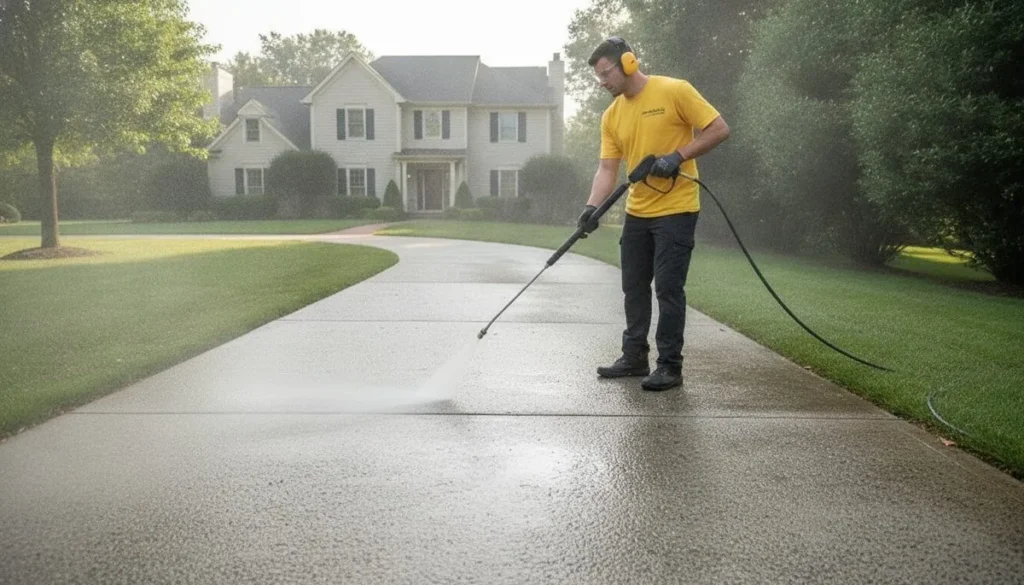
A professional driveway wash is not a nozzle pointed at concrete until the dirt disappears. The sequence matters. It controls surface damage, treats stains before they spread, and keeps dirty water from reaching the storm-drain system.
- Inspect the driveway. Start by identifying the material, drainage path, existing cracks, loose joints, and areas of spalling. Cleaning can expose maintenance issues, but excessive pressure can worsen weak spots. A careful inspection follows the same basic principle recommended for roadway maintenance: check the physical condition before work begins. Review the EPA maintenance guidance for the inspection basis.
- Apply a pre-treatment. An eco-friendly cleaning solution is applied to break down algae, mildew, and other organic growth before the main wash. This lets chemistry do part of the work instead of forcing the surface to withstand unnecessary pressure. The solution should be selected for the driveway material and used with runoff controls.
- Wash with the right pressure and equipment. Concrete, asphalt, and pavers do not receive the same treatment. A surface cleaner can produce an even result on sound concrete, while asphalt needs controlled pressure because aggressive washing can dislodge its bitumen binder. Pavers may need a gentler approach around joints. The goal is uniform cleaning, not maximum force.
- Pre-treat oil and embedded stains. Oil spots are handled before washing with absorbent materials and an appropriate degreaser. That breaks down the contaminant and helps prevent it from being pushed toward a storm drain. Do not blast an oil stain across the driveway and call the job finished. EPA vehicle-washing guidance supports absorbent and spill-control practices.
- Rinse, inspect, and verify. Rinse the surface methodically, check edges and low areas, and look for remaining organic growth or stain shadows. Professional work also includes managing the wash water in line with applicable local stormwater requirements. New York driveway cleaning is not complete if contaminants are simply redirected into a drain.
- Seal when the surface calls for it. Sealing is optional, not automatic. Once the driveway is clean and fully suitable for protection, the right sealer can help preserve concrete, asphalt, or paver surfaces. Pavers may benefit from a sealer that helps hold joint sand in place and limits weed and moss growth.
That process takes longer than a quick rinse, but it leaves the driveway cleaner without treating the surface, landscaping, or waterways as expendable.
Driveway Sealing and Maintenance After a Wash
Cleaning comes before protection
Do not seal a driveway while dirt, algae, salt, or oil is still sitting on the surface. Washing is the preparation step. It exposes cracks, spalling, worn areas, and other maintenance needs before a protective product goes down. The surface must also be clean and properly dry so the sealer can bond instead of trapping contaminants underneath. The EPA identifies surface cleaning as preparation for maintenance and surface protection.
That inspection matters on Long Island, where moisture, coastal exposure, and winter deicing materials work against exterior surfaces. A clean driveway makes damage easier to see. Repair the problem first, then choose protection that matches the material.
Concrete needs moisture and salt protection
Concrete is porous. A suitable sealer helps limit moisture penetration and reduces the impact of salt carried onto the driveway during winter. Periodic cleaning and sealing can help a concrete driveway last for decades when cracks and surface damage are addressed instead of ignored. Do not use sealing as a substitute for repair. It is a maintenance layer, not a fix for a failing slab.
Keep the schedule practical. For many residential driveways, annual cleaning is a sensible baseline, with timing adjusted for shade, tree cover, coastal exposure, traffic, and winter salt. Rinse off heavy salt buildup when conditions allow, remove spills quickly, and watch for cracks that widen after freeze-thaw cycles.
Asphalt and pavers require different care
Asphalt should be cleaned with controlled pressure. Excessive force can dislodge the surface bitumen and accelerate breakdown. After cleaning and drying, asphalt sealing helps shield the pavement from water infiltration and oil spills. EPA maintenance guidance supports sealing asphalt after cleaning to protect it from moisture and environmental stressors.
Pavers have a different weak point: the joints. A compatible sealer helps lock joint sand in place, which reduces the openings where weeds and moss can establish. Sealing also supports stability, but only after displaced units are reset and eroded joints are corrected. Otherwise, the sealer preserves an unstable surface.
Clean, sealed hardscape improves the first impression of the property. Well-maintained exterior surfaces strengthen curb appeal and can support property value. That is true whether the project is a driveway, walkway, or the surrounding exterior. For broader property maintenance, see our roof cleaning in Hampton Bays service page.
Before you pressure wash, seal, or repair your driveway, get a surface-specific recommendation.
Request a free driveway estimate.
Frequently Asked Questions
How much does driveway pressure washing cost in New York?
Most residential driveway pressure washing projects fall between $100 and $350, with a national average near $210. Your price depends on square footage, surface type, stain severity, access, and whether pretreatment or sealing is needed. A typical driveway takes one to four hours to clean, depending on its size and contamination level. See the published cost range and square-foot pricing guidance.
Is pressure washing safe for asphalt driveways?
Yes, when the operator uses the correct pressure and technique. Extremely high pressure can dislodge asphalt’s top bitumen layer and accelerate breakdown. Asphalt usually needs a controlled wash, careful inspection, and enough distance from the surface to clean without stripping the binder.
How often should I have my driveway cleaned?
There is no single schedule for every Long Island driveway. Annual cleaning is a practical starting point for many homes, but coastal exposure, winter deicing salt, shade, algae, traffic, and oil drips may require earlier service. Inspect the surface each spring and clean it before buildup becomes embedded.
What is the difference between pressure washing and soft washing?
Pressure washing removes soil mechanically with pressurized water. Soft washing applies specialized cleaners at low pressure to loosen algae, moss, and organic grime before a controlled rinse. Use the lowest effective pressure for asphalt, pavers, ornamental stone, and surfaces with existing damage. Low-pressure soft washing helps preserve surface integrity.
Can washing remove oil stains from concrete?
It can significantly reduce many oil stains, but results depend on the stain’s age and depth. Treat the spot first with absorbent material and an appropriate degreaser, then wash it. This approach also helps keep oily runoff away from storm drains, consistent with EPA vehicle-washing guidance: EPA runoff management practices.
Schedule Your Driveway Cleaning Estimate
A surface-specific cleaning plan helps protect concrete, asphalt, or pavers from avoidable damage while addressing the stains and buildup common on Long Island properties. Get a clear recommendation for your driveway before work begins.