A layer of pollen, salt residue, or bird droppings is not a reason to put a pressure washer on your roof. Solar panels are electrical equipment with sealed edges and brittle silicon cells. The wrong cleaning method can create damage you cannot see until output drops or a warranty claim is denied.
Solar panel cleaning Long Island should use soft washing: a gentle, low-pressure rinse and soft-bristle cleaning method that avoids walking across the array. The U.S. Department of Energy says regular precipitation often handles routine dust, but prolonged dry spells can leave panels visibly dirty and justify a gentle rinse (U.S. Department of Energy).
Pressure washing can cause micro-cracks in silicon cells, while soft cleaning follows the maintenance approach specified by major manufacturers, including SunPower, Tesla, LG, and Panasonic. On Long Island roofs, the decision starts with understanding what collects on your panels, when cleaning is actually needed, and why the method matters more than force.
Why Solar Panel Cleaning Long Island Homeowners Should Schedule Regularly
Coastal air and tree cover create heavier buildup
Long Island solar panels deal with more than ordinary household dust. Salt spray from the coast can leave a film on the glass. Spring pollen sticks to that film. Bird droppings create stubborn, shaded spots, while Long Island’s dense tree canopy adds needles, leaves, and fine debris to the roofline.
Rain removes some surface dust, and the U.S. Department of Energy notes that regular precipitation is often enough for routine cleaning. A prolonged dry spell is different. When grime remains on the glass, less sunlight reaches the cells, and the system may produce less power. Depending on the type and amount of buildup, homeowners commonly cite efficiency losses in the 15 to 25 percent range.
Watch the production data in your system’s monitoring app. A gradual dip, paired with visibly dirty panels, is a reason to schedule an inspection rather than assume the equipment has failed.
Cleaning protects a long-term investment
Solar panels are built for years of outdoor exposure, but the glass, seals, and cell connections still need the right care. Pressure washing can create microscopic cracks in brittle silicon cells. You may not see the damage immediately, yet repeated heating and cooling can expand those fractures and reduce power output over time.
Incorrect cleaning methods can also put a manufacturer’s warranty at risk. If a later inspection traces panel damage to aggressive washing, a warranty claim may be denied. That makes the method more important than chasing a rigid cleaning schedule.
Why soft washing is the safer choice
Soft washing uses controlled, low-pressure cleaning rather than the concentrated force designed for concrete or masonry. The work should protect the panel surface, avoid walking across the array, and follow the equipment manufacturer’s maintenance guidance. Read more about soft washing solar panels and the low-pressure approach.
Gulf2Bay Softwash has cleaned 4,258 houses and is SoftWash Systems certified. The same surface-specific discipline matters when caring for both the roof and the array. For homeowners planning broader maintenance, see Long Island roof and solar panel cleaning.
Do not let a generic pressure washer treat your solar investment like a driveway. Use a method designed for the equipment on your roof.
The Risks of Pressure Washing Solar Panels
High pressure can damage the cells beneath the glass
A pressure washer is built to strip grime from concrete, siding, and other durable surfaces. Solar panels need a different approach. A typical pressure washer operating at 2,000 PSI or more delivers concentrated force that can damage the brittle silicon cells beneath the glass.
That impact can create micro-cracks, tiny fractures that are not visible during a routine inspection. The cracks can interrupt electrical pathways and reduce power output permanently. The panel may look clean when the work is finished, while the damage remains hidden inside the module.
Solar panels can be rated to withstand environmental stress such as 100-mph winds and heavy hail. That does not make them suitable targets for a pressure washer. Wind and hail distribute force differently. A nozzle concentrates water into a narrow, aggressive stream.
Water intrusion can cause delamination
High pressure can also force water past the edge seals that protect the laminate beneath the panel glass. Once moisture gets inside, the layers can begin to separate, a failure known as delamination. Water intrusion can affect the components that keep the module operating reliably and may spread beyond the original point of impact.
Specialized sealants hold the panel components together. Pressure washing can compromise those sealants and create another path for moisture to enter. The result is not ordinary surface dirt that can be rinsed away. It is damage to the panel’s construction.
The most expensive damage may appear later
Pressure-washing damage is often cumulative. Repeated cleaning can worsen small weaknesses until a panel fails or its production drops. Because micro-cracks, compromised sealants, and early delamination may be invisible, the connection to cleaning can be missed for months or years.
That timing matters when a warranty claim is filed. A manufacturer may inspect the failed panel, trace the problem to an incorrect cleaning method, and deny coverage. A clean-looking array is not proof that pressure washing was safe.
For soft washing solar panels, the safer standard is controlled application rather than concentrated force. Gulf2Bay uses a low-pressure process capped at 90 PSI, keeping the cleaning action gentle enough to protect the panel surface, edge seals, and surrounding roof system.
How Soft Washing Safely Cleans Solar Panels
Solar panels need a cleaning method that removes organic buildup without stressing the glass, seals, or mounting system. Soft washing combines controlled water pressure with surface-appropriate cleaning solutions. The result is a clean array without the concentrated impact of a pressure washer.
| Method | Pressure | Cell Risk | Warranty Safe | Best For |
|---|---|---|---|---|
| Pressure Washing | 2,000+ PSI | Micro-cracks, delamination | No | Concrete, masonry, driveways |
| Soft Washing | 90 PSI max | None | Yes | Solar panels, roofs, siding |
Low pressure does the important work
Gulf2Bay keeps the water pressure at a maximum of 90 PSI for this type of delicate-surface work. That is enough to rinse away loosened dirt, pollen, and residue, but far below the force used to clean concrete or masonry.
The process follows a straightforward sequence:
- Inspect the array and roof system for existing damage or debris.
- Apply a biodegradable cleaning solution to dissolve organic growth at the root.
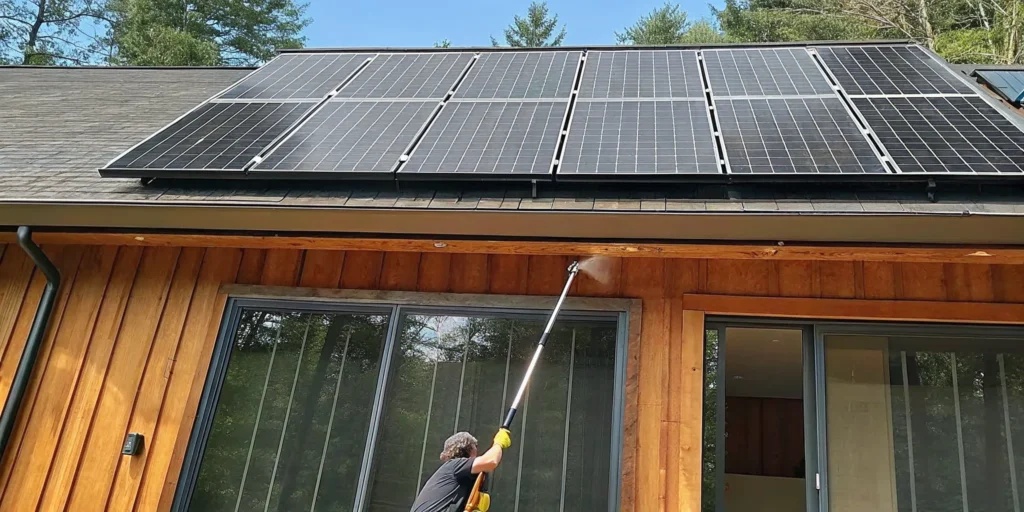
- Rinse with controlled low-pressure water using a soft-bristle brush on a water-fed pole.
- Finish with deionized water so the glass dries clear, leaving no mineral film behind.
The biodegradable solution addresses organic growth at the root instead of simply striking the surface until it looks clean. This matters when panels are exposed to Long Island’s pollen, tree debris, coastal moisture, and bird deposits. A cleaner should remove the contamination without forcing water into the panel’s edge seals or stressing the laminate.
For a closer look at the process, see soft washing solar panels. It explains why chemical treatment and controlled rinsing are better suited to delicate exterior materials than aggressive pressure.
No one walks across the array
A water-fed pole with a soft-bristle brush reaches the panels from the ground or the roof edge. The brush lifts surface debris while the pole keeps boots, ladders, and unnecessary weight off the exposed glass. This approach also reduces the chance of striking a panel or disturbing its hardware during the work.
Deionized water provides the final advantage. Water with fewer than 10 parts per million of dissolved minerals evaporates without leaving the white mineral film that tap water can deposit. The panel surface dries clear, with no residue left to scatter light or create another cleaning problem.
Surface-specific roof experience matters
Solar panel cleaning should be handled as part of the roof system, not as an isolated glass-washing job. Gulf2Bay is SoftWash Systems certified and has experience with delicate surfaces across more than 4,258 houses. The same care applies when solar panels or solar tiles are included with Long Island roof and solar panel cleaning.
That distinction matters on premium Long Island homes, where cedar, specialty roofing, flashing, and mounted equipment may share the same roofline. Inspect the surface first, use the least aggressive effective method, and keep the crew off the panels. That is the standard for safe solar panel cleaning Long Island homeowners can rely on.
How Often Should You Clean Solar Panels on Long Island?
For most Long Island homeowners, professional solar panel cleaning once or twice a year is a practical maintenance schedule. The right interval depends on what lands on the array, how long dry weather lasts, and what your production monitor shows.
Rain helps, but it does not remove every local contaminant
The U.S. Department of Energy says regular precipitation is usually enough to handle routine dust on solar panels. Minor dust during a prolonged dry spell may not significantly affect performance, and a gentle hose stream is sufficient if panels become particularly dirty during drought conditions. Read the Department of Energy solar maintenance guidance.
Long Island arrays face more than ordinary dust. Dense tree canopy can leave pollen, sap, and organic debris on the glass. Coastal properties also receive salt spray. Those conditions make a scheduled inspection worthwhile, especially for homes near the South Shore and the Hamptons. This guide to protecting solar panels from salt spray explains why coastal exposure deserves extra attention.
Watch for these signs that cleaning is due
- Visible bird dropping buildup: A few spots are not an emergency, but concentrated buildup can shade the cells beneath it and will not always wash away quickly.
- A noticeable efficiency dip: Compare your monitoring app with normal production for similar weather and season. If output is lower than expected, contact the installer before assuming dirt is the cause. The Department of Energy recommends contacting the installer when a system is not producing as expected.
- A prolonged dry spell: Several rain-free weeks can leave dust, pollen, and coastal residue on the array. Schedule an evaluation rather than scrubbing the panels yourself.
Schedule a professional check after severe weather
After a severe storm, have the array and surrounding roof checked for debris, shifted components, or visible damage before anyone cleans it. Do not walk on the panels or use a pressure washer. A professional can determine whether the issue is surface contamination, storm damage, or a system problem that belongs with your solar installer.
Think of cleaning as protective maintenance, not a race to wash after every shower. A one-to-two-times-per-year schedule, adjusted for tree cover, salt exposure, bird activity, and dry weather, keeps the decision tied to actual conditions.
Frequently Asked Questions
How often should I have my solar panels cleaned?
Most Long Island homeowners should plan on cleaning once or twice a year. Schedule sooner after a long dry spell, heavy bird dropping buildup, or a noticeable production decline in your monitoring app. Rain usually removes routine dust, but coastal salt, pollen, tree debris, and limited rainfall can leave residue behind.
Is it worth paying to have solar panels cleaned?
It can be, especially when panels sit beneath trees, near salt air, or on a roof that is difficult to access safely. Cleaning removes buildup that blocks sunlight without putting you on a ladder or walking across the panels. The method matters. A gentle hose stream, soft brush, and low-pressure process are safer than aggressive pressure washing.
How much should I pay to clean my solar panels?
There is no responsible one-size-fits-all price. The total depends on the number of panels, roof height and pitch, access, buildup, and whether related roof surfaces need attention. Request a site-specific assessment rather than choosing a provider by the lowest quote. Confirm that the work avoids high pressure and walking on the panels.
What is the 33% rule in solar panels?
The phrase can refer to different solar discussions, so ask the person using it to define the rule before relying on it. It is not a cleaning standard. For maintenance, focus on the panel manufacturer’s instructions, the condition of the array, and a cleaning method that uses low pressure and soft tools.
Ready to Schedule Solar Panel Cleaning?
A careful assessment can show whether dirt, pollen, or coastal residue is affecting your panels and identify the safest way to clean them. Schedule a free solar panel cleaning consultation with Gulf2Bay Softwash. Schedule a free solar panel cleaning consultation with Gulf2Bay Softwash to discuss your Long Island home and next steps.